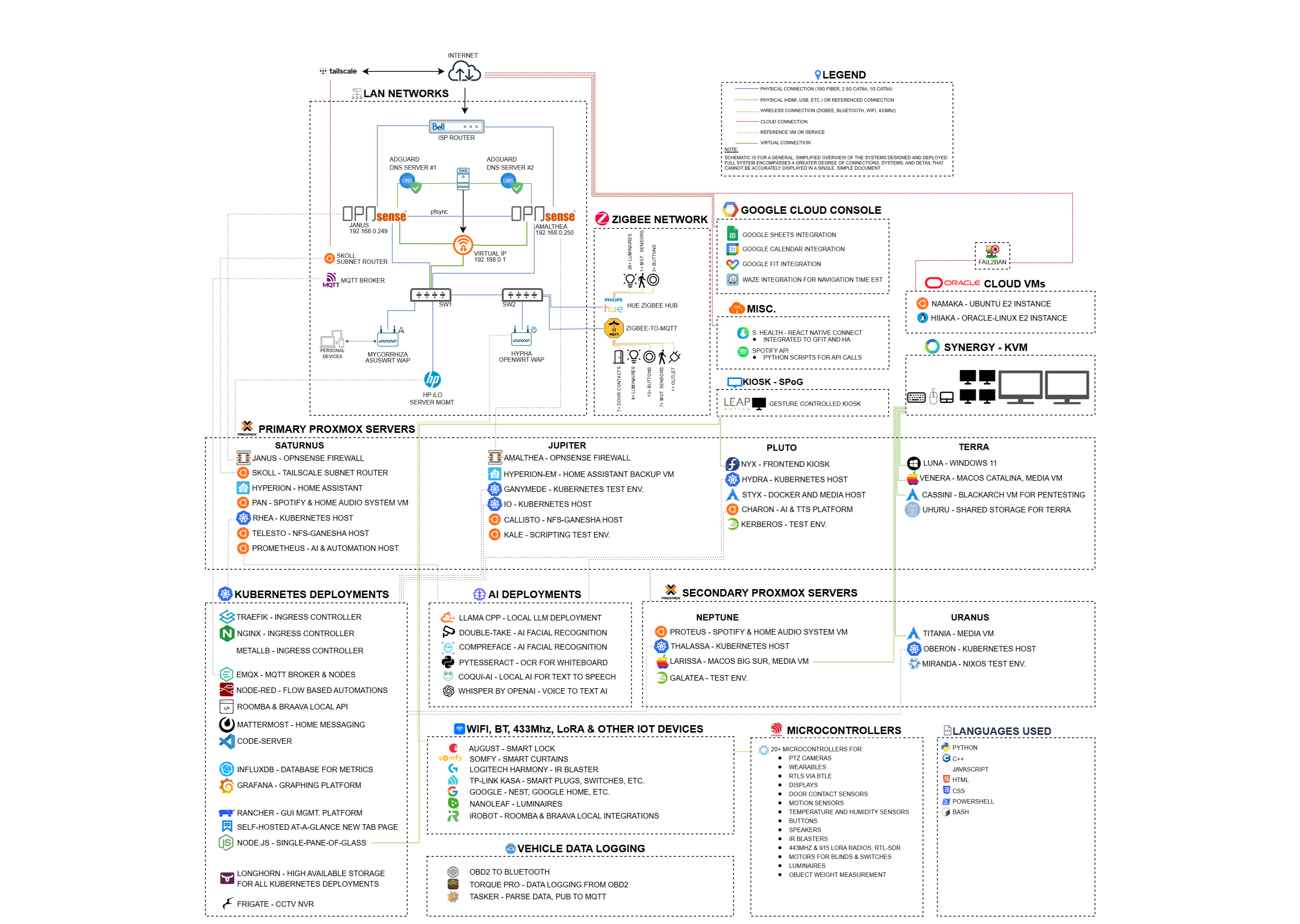
I built this homelab to learn, test, and simulate the kind of distributed, high-availability systems found in real enterprise environments. Real cloud environments are expensive and restrictive, so I wanted a fully self-hosted space where I could experiment with architecture, AI, automation, networking, and platform engineering, without limits or ongoing costs.
Network Architecture
My network foundation mirrors a small enterprise environment: dual OPNsense HA firewalls, a 6-node Proxmox backbone, and a fully distributed Kubernetes platform. Load balancing, DNS, VPN, VLAN isolation, and cloud failover ensure the entire environment behaves like a production datacenter.
Systems & Infrastructure
Dozens of VMs and containers run compute, security, monitoring, storage, and voice/video services. Everything is tied together with observability (InfluxDB/Grafana), strict authentication, and automation-driven resilience. Cloud-connected OCI nodes provide a secondary footprint for redundancy and experimentation.
Automations
Home Assistant orchestrates a vast automation mesh powered by MQTT, custom firmware, backend services, and locally hosted APIs. Nearly every device: Zigbee, WiFi, BLE, sensors, motors, RF modules, displays, is unified through my single-pane-of-glass UI and event-driven automation engine.
AI & Machine Intelligence
AI runs locally, not in the cloud: on-prem LLMs, speech recognition, face recognition, OCR, and custom inference pipelines. My JARVIS assistant integrates voice, vision, and context to automate home and infrastructure tasks with real-time, fully offline intelligence.
Highlights:
My approach was to recreate enterprise infrastructure from the ground up using open-source tooling, HA design principles, and automation-first architecture. Everything is orchestrated through Proxmox, Kubernetes, HA networking, and event-driven automation. I combine virtualized services, embedded hardware, local AI, and custom software into one cohesive ecosystem: monitored, secured, self-healing, and scalable. The result is a hybrid playground and production-grade lab where I can prototype, test, break, and rebuild any system I want.